Online formats took 78% of all UK ad spend in 2023: report
Online formats such as search, display (including social media) and BVOD drove ad spend growth in 2023, with out-of-home the only other medium to see increased expenditure.
Online formats such as search, display (including social media) and BVOD drove ad spend growth in 2023, with out-of-home the only other medium to see increased expenditure.

Twenty five percent of senior client-side execs say AI skill-building programmes have already been conducted. However, advanced AI skills for key team members and an org-wide basic understanding of AI remain as top priorities for generative AI progress in 2024, according to a report from Adobe.

Katrina Smart is Commerce Media Director, Europe, at The Mars Agency, and has a decade of experience in retail strategy and media planning. We caught up with Smart to get an insider’s view on just how much commerce media has changed in the last two years. Smart also gives us the lowdown on what advertisers […]

In March, the China Internet Network Information Centre (or CNNIC) released the 53rd Statistical Report on China’s Internet Development Status: a comprehensive twice-yearly snapshot of digital life in China. Covering everything from device usage to China’s rural internet population, livestreaming growth to online ride-hailing, the report delves into the major trends shaping China’s internet landscape […]

We’ve seen lots of examples of new intelligent search features or conversational agents in the last six months in online retail – from Walmart, Instacart and Amazon, for example. In a recent article, I tried out some AI-powered product discovery features to see how useful they might be for shoppers. And though they each provided distinctive […]

Augmented reality has surged in the headlines of late with the release of Apple’s Vision Pro headset and Meta teasing a potential rollout of AR glasses as it marks the 10-year anniversary of its VR/AR outfit, Meta Reality Labs. If augmented reality headsets and eyewear become more commonplace, brands and entertainment companies may take the […]

A joint report from Salesforce and the Retail AI Council suggests widespread retailer investment in generative AI – but a lack of structure and guardrails to ensure it is used effectively and above all, ethically.

Nearly two thirds of consumers rank data security as critical to their CX expectations. They want to know their data is being looked after, especially in the hands of generative AI.

A roundup of research that paints a picture of the growth, but also the context for the growth, in retail media.

The connected car requires a big transition at OEMs, including new commerce capability to be able to engage seamlessly with customers through sales, after-sales, and in-car commerce.

VML’s luxury retail lead Ricardo Catalano outlines three tiers of digital maturity in the sector, and why some maisons take a traditional approach with minimal data activation, despite placing a premium on customer relationships.

How has the discount marketplace become such a ubiquitous name in such a short space of time? How does it compare to Shein? And what does this trend mean for Amazon?

You might have heard that TikTok is the ‘new Google’ based on a stat that two fifths of Generation Z are apparently using it for search. But where did this idea come from, and is it accurate?
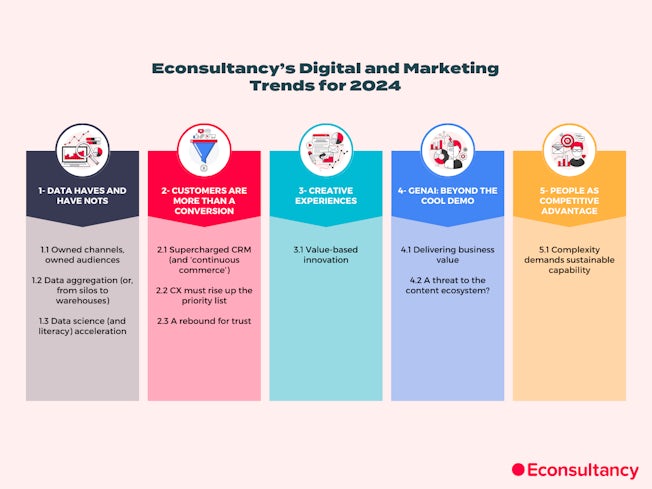
We’ve published a list of digital and marketing trends every January at Econsultancy for well over a decade, and have been training marketers for the better part of 20 years. Looking back at some of our annual predictions since 2010, three types of trend stand out: Trends that feel nostalgic, ideas that quickly became amusing […]

This scorecard is designed to help score your organisation and teams against the criteria that are most important to digital culture.

Retail media is evolving into a solution that can address the whole funnel – not just the bottom bit where a sale is made. What might this look like in 2024, and what are the implications for privacy?

The space is increasingly crowded with competitors and with few unifying standards to join them together.